Showing posts with label Japan. Show all posts

Sunday, April 22, 2012

Eating Our Way Through Japan

So our whole trip through the Philippines and Japan has been great food adventures for us.  And we're sure it will continue as we go through the rest of East Asia.  Of course we eat the usual Japanese foods: sushi, ramen, and curry; all were delicious.  But we got to try a couple of other things as well.


Anthony Hungry = No Time for Pictures; Curry Yummy

Ramen, Gyoza, and Fried Rice
Takoyaki

This food is at the heart of Japanese street food. Takoyaki is snack of  pancake-like batter balls filled with octopus, green onion and pickled ginger. It is served with four or five on a skewer slathered with a sauce. This savory snack is cooked on a special grill by dedicated men and women who pour, flip, rotate, and stab these takoyaki until they are ready to eat, still boiling hot. We purchased our first set from a lovely women who proclaimed even though her shop was small (the entire shop can be seen in the photo) her takoyaki are as good as anybodies. They are. If you ever make it to Japan and need a snack, keep your eyes open for the takoyaki vendors.

Fugu

In an earlier post we talked about fugu from the perspective of a language barrier, but we did not talk about what it is, so here we go. Fugu is pufferfish, most probably Japans most notorious sashimi. This is because the fish contains lethal amounts of a sodium channel blocker, a poison that if consumed will cause paralysis resulting in asphyxiation and death. Because of this all restaurants that serve fugu go through an intense governmental licencing program and all chefs that prepare it are required to go through extensive training. Even with the intense training and regulation there are still some deaths from fugu. So it was a goal of Darin's to eat it, obviously. And as it happens, across from the capsule hotel was a fish tank filled with pufferfish advertising the restaurant as specializing in fugu.

We enjoyed it as sashimi and as a table-top barbecued. The sashimi tasted like spring, it was served on raw cabbage with some fresh green onion and some other fresh vegetables. Very light and refreshing, absolutely delicious!

The cooked version had three different cuts of the fish; skin, flesh and flesh with bone. Our favorite was the bone-in cut. All of the barbecued fish and vegetables were basted in an incredible ponzu sauce that could make anything taste great. Overall, two more fugu lovers have been added to the world.

Kobe

We have all heard of Kobe beef, and on a map we saw the city of Kobe. How could we pass up such an opportunity? So having no idea if the name was merely a coincidence we hopped off the train and made a b-line for the information desk. Clearly we are not the first tourists to ask about this since the woman handed us a map of the area with restaurants that serve Kobe beef.

So for 9,240 Yen or 123 USD we split one “special Kobe beef” lunch, with a five course meal including Kobe beef. The meal started with some thinly sliced raw beef, not Kobe, then the salad and oxtail soup. For the main course we had 110 grams of Kobe beef cooked by our own personal chef right in front of us, and dessert included peach sorbet and tea.
Our Chef Cooking the Vegetables

Our 110g of Kobe Beef

Darin Dining on His Kobe Beef


In an earlier post Anthony had mentioned that Hida beef was just as good as Kobe beef. I have to agree, Kobe beef is just as good as Hida beef. Talking and comparing the two meals we came to one final conclusion; eat Hida not Kobe. Why? There is a fairly noticeable difference in price of the two beefs and we could find no justification for it other than the celebrity status of “Kobe”. Granted both of these beefs are uber indulgences and the consumption of either is the definition of gluttony, one fact remains.  Eat Hida not Kobe!

From Our Hida Beef-eating Experience


Okonomiyaki
As we were wandering Kyoto, we stumble across a little cherry blossom festival and see tons of food vendor stalls.  Half of them must have been cooking things in these cupcake tins and we were curious.  They fill each one with batter, a lot of cabbage, an egg and a piece of ham.  After a couple of minutes, the cook deftly flips it over and lets the other side cook.  After a couple more minutes, they're done and ready to be eaten.  And we purchase one not knowing what it truly is.  Overall, it was yummy.  Anthony didn't care too much for it, but I thought it was good.

As we head to Osaka and Hiroshima, we read about the two cities on wikitravel and find out that what we ate what is called Okonomiyaki.  These two cities are actually known for their versions of Okonomiyaki with Osaka making the snack with a thick pancake-like battter in the bottom and Hiroshima making their version with a thin crepe-like bottom and a lot of noodles.  Both have tons of cabbage, egg, and ham or bacon to top it off.

While in Osaka, sitting in a bar, we strike up a conversation with the bartender and mention that we had Okonomiyaki in Kyoto.  She responded with, "why?"  At the time, we really didn't know better, so we were just trying it.  I guess the people of Osaka know that their city is the city to have Okonomiyaki.  Sadly, even with her recommendation (and with the same recommendation from a different bartender in a different bar), we didn't get to try Osaka Okonomiyaki.  But we get to Hiroshima and hear that there are a couple of places where there are stalls after stalls selling Hiroshima Okonomiyaki and we head off.

Prepping the Crepe-like Bottom

Cooking the Egg for the Top

Darin Enjoying his Okinomiyaki
This version was yummy.  Anthony and I both agree that this was definitely better than the Kyoto one we had, though we weren't able to compare it to Osaka.  

Friday, April 20, 2012

Kinosaki Onsen


With the versatility of our JR pass we opted to spend a night in the small town of Kinosaki. There is but only one thing this very small town is known for: onsens. An onsen is a Japanese hot springs. For those Nor Cal folks, think of Calistoga. This town has seven public onsens and if you stay with certain ryokans in town you get a pass that allows you into all of them. So that is what we did, we booked a beautiful ryokan, checked in, changed into our yukatas, and headed out.

Walking up and down the street from onsen to onsen are couples and small groups all dressed in the yukata from their respective inns and walking in their geta (traditional wooden sandals) making clacking noises on the cobble stone street.

We also once again got to see cherry blossoms lining the street and waterway, lit up at night by hanging lanterns.


All in all this was one of the most relaxing times of our trip, flowing from onsen to onsen drinking beer and plum wine while munching on warm crab-stuffed steamed pastry buns. Highly recommended.

Tuesday, April 17, 2012

Japan travel tips

So for those wanting to travel to Japan, here are a couple of sage advices from us to you.

Tip #1: Learn Japanese
So you don't really need to learn Japanese to come to Japan. You can always bring your Japanese friend or Japanese sister-in-law with you. We kid of course. Getting around Japan knowing no Japanese and being fluent in English has been more than adequate. Not as easy as getting around the Philippines of course but I have a feeling that it might be more difficult in South Korea, China, and Vietnam. There are plenty of people in Japan that speak English. We really only had one tiny problem, which is why we thought of this tip.

Our language barrier at a Fugu (puffer fish) restaurant in Osaka was quite the experience. We sit down and look over the drink menu and the picture/english menu. We pick out two items from the menu and look over the drink menu. We tried ordering sake and the waitress kept saying "wata". So we thought she was asking us if we wanted water. We said yes. But she kepts saying the same thing after ordering the sake. And after not understanding her questions, our waitress kept giggling and turning to the other waitress in confusion. They too knew little to no English. So we decide that no sake for us. I post the picture in hopes that someone (Fumi) might be able to shed some light on our drink confusion.


So after being settled w/ our dinner order and water for drinks, the waitress comes back and asks us another question in Japanese. She points to the Japanese menu and we infer that we have an option for our meal. Darin thinks we get to choose which part of the puffer fish we want for our bbq plate. So we try to ask the waitress, "head, body, tail" and point to the appropriate body part. More giggling and looking at her waitress friends. After a couple more minutes of this, she runs of and finds another waitress who can speak English. Turns out, we get a choice of sauces for our bbq dish. So having spent around 10 minutes in utter confusion, as soon as the English speaking waitress says that one of our sauce choice is ponzu, I immediately ask for that since I know and like ponzu.


We also got to choose to have vegetables with our fugu. The only thing we were able to decipher from our waitress was mushroom. And the rest we tried to figure out on or own when it arrived. We were able to figure out the bell pepper and the leek, but that was it. There was an okra-looking thing that tasted like a very mild pepper. And there was a potato-looking thing that was crunchy like a water chestnut.


To add to the problems in communication, I see this little contraption on the table and thought it might dispense a toothpick or napkin or something. So I grab it, press the button, and say, "what's this do?" Darin knew exactly what it was but it was too late. The waitress comes by and Darin waves his hand saying "no, no, sorry" in his limited Japanese. The little contraption is generally used to call the waitress to your table. Who knew? Ooops, my bad.


Tip #2: JR Pass
A couple of weeks before leaving for this trip, I had a couple of friends give us this advice to purchase a JR pass. And since you can only purchase this pass outside of Japan, it was best that we purchase it before leaving for the trip. Granted, you can get the pass in other Asian countries as well, but for the sake of simplicity, we just got our pass at a travel agency in Little Tokyo in Los Angeles.

The JR pass allows travel on all JR busses and trains in Japan, which include most bullet trains and at least one line in most big cities. Getting around in cities would require paying for the local metro, but we were still able to get by without doing that since we walked around quite a bit. In total we used a local metro twice in Tokyo and once in Fukuoka. We then used our JR pass six times within Tokyo and six times within Kyoto. But we primarily used our passes to get in between cities which accounted for all of our 7 train rides in our transportation tally. And the best part was that we were able to change our tickets whenever we wanted. We actually changed our city destination twice and changed to an earlier departure time 3 or 4 times.
Our 14 day pass cost us 41,000 yen a piece and doing a rough calculation, our trips would have added up close to 60,000 yen per person. And that doesn't include the reservation costs or the change fees that we might have had to pay. So the pass even gave us more flexibility than what we would have normally done if we hadn't bought the pass.

Darin As a Bullet Train

For those only spending a week in Japan, the JR pass would pay for itself if all you do is Tokyo and Kyoto. A 7 day pass costs 28,000 yen and a round trip ticket from Tokyo to Kyoto is 26,000 yen. With the round trip cost of getting from Narita airport into Tokyo at 3000 yen a piece, your 7-day pass would have paid for itself. If you're an intense traveller and visit 3 cities in 7 days, then you're making some great savings. If you were to do Tokyo-Kyoto, Kyoto-Hiroshima, Hiroshima-Tokyo, it would cost 42,000 yen total. Meaning the 14-day JR pass would have paid for itself and adding more stops and cities would all be savings.

So Darin and I concluded halfway through our Japan trip that the JR pass was a good investment. Even though it cost us close to $500 each.

Need help figuring out where to go in Japan? www.japan-guide.com. Need help figuring out how much it might cost to get from Japanese city to Japanese city? www.japan-guide.com. Need help figuring out when the cherry blossoms will be in bloom and where to see cherry blossoms? www.japan-guide.com.

I used this site a lot and help me figure out the best way to get to Hida-Takayama and Kinosaki Onsen. Plus the various ideal places to view cherry blossoms. Very helpful site for those english speakers visiting Japan.

Tip #4: Shoes that you can easily remove
You would think that I would know this already, but man, did we have to remove our shoes a lot. I love walking around in socks or go barefoot, so I don't mind at all. What I do mind was having to untie and tie my shoelaces up over and over again. If only there was an invention where i can easily unstrap and strap my shoes. Oh wait. It's called velcro. Sadly, I don't have any velco shoes. Nor did I bring any slip-on shoes. My slip on shoes are dress shoes or a pair of vans (which don't provide much arch support). So I pretty much loosened up my shoelaces instead and walked around with loose shoes and was able to slip my shoes off and on fairly easily.

Tip #5: On a budget? Stay at a capsule hotel
This tip only works best if you're male and not claustrophobic. Yes, I said male. Apparently, there are no capsule hotels for women. And the savings is far greater if you are travelling alone since for two, the savings wasn't as great as staying in a hotel since you're paying per person as oppose to paying for a room.


Our Capsule Hotel in Osaka


Darin and I got to stay in a capsule hotel in Osaka. It was pretty great, but not something we would do regularly as we kept hitting the walls as we moved around in our sleep.

Tip #6: Japan uses 100V for electrical equipment
Previously, I recommended bringing an internation adaptor/converter instead of just an international adaptor. Scratch that tip. Instead, make sure you only bring electronics that accept anything from 100V-240V. The converter we bought in the Philippines didn't work out quite well in Japan and I ended up killing my electric shaver. So I tossed that away and bought a new shaver in Japan. One that takes 100V-240V. So with my international adaptor, this shaver should work anywhere in the world. Now the only thing that Darin and I have than need a converter is the hair clipper. Hopefully, we can start using it again in Korea or China.
Kyoto

On A Bike

Reading up on Kyoto, a couple of travel sources recommended renting bikes to get around Kyoto. So at the train station, Darin picked up a flyer for a bike rental shop where we can rent a single speed bike for 800 yen and a 3-speed bike for 950. Darin opted for a one speed and being sick and not wanting to expend a lot of energy, I went with the 3-speed. In hindsight, we both would have been able to get around town in a single speed since Kyoto is fairly flat and I only needed to use the higher gear twice.

Renting a bike was a pretty great idea since we were able to see quite a bit of the city at our own pace. We got to come and go throughout town and not have to wait around for public transportation.

So what is there to see in Kyoto? Gardens and temples. And this being cherry blossom season, we got to see quite a bit of cherry blossoms in gardens and temples.

Willowy Cherry Blossom


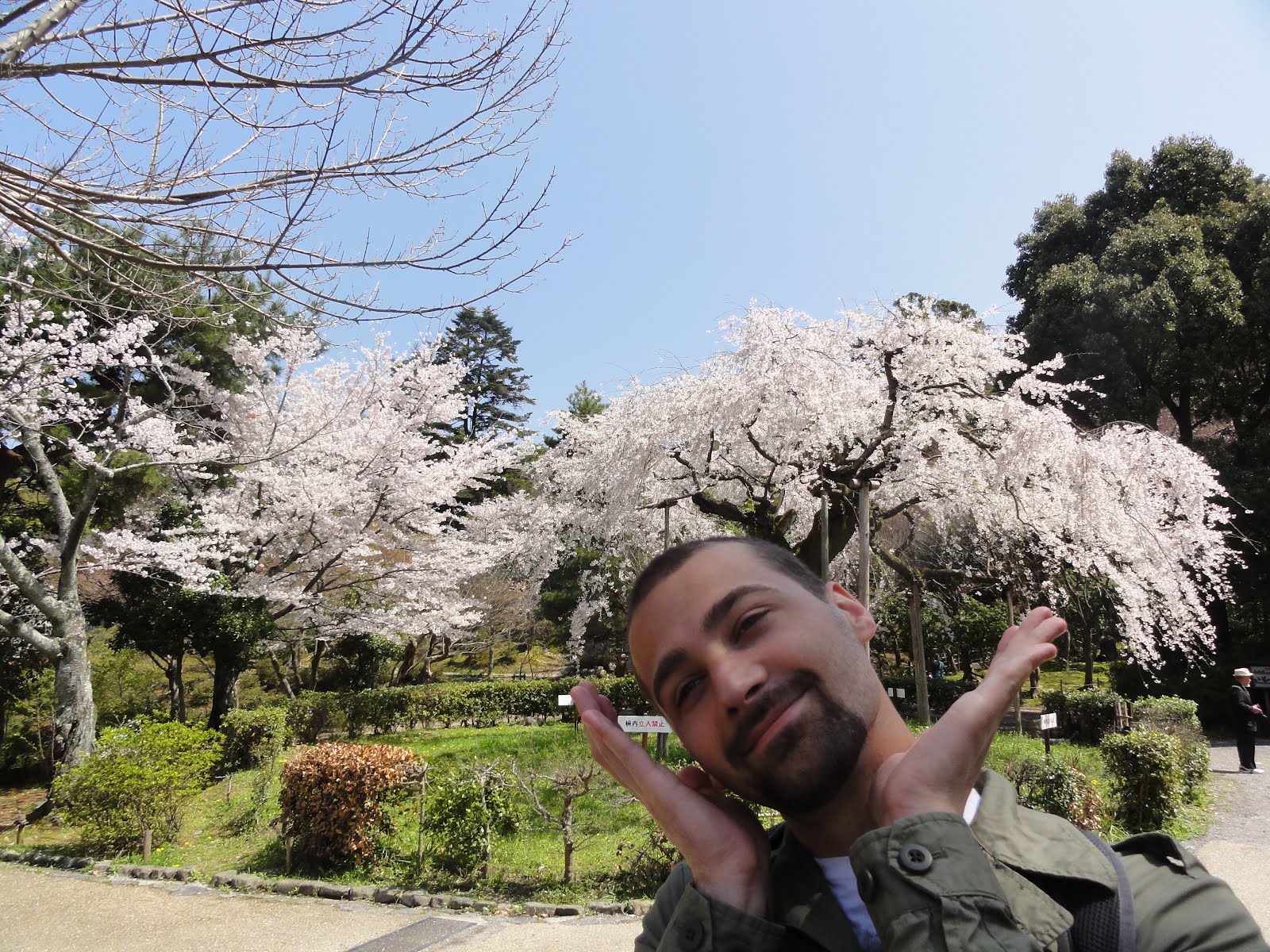
Darin in His Cherry Blossom Pose

Cherry Blossoms by Buddha

Cherry Blossoms by a Cemetery

Cherry Blossoms by a Creek

Pink Ones and Pinker Ones

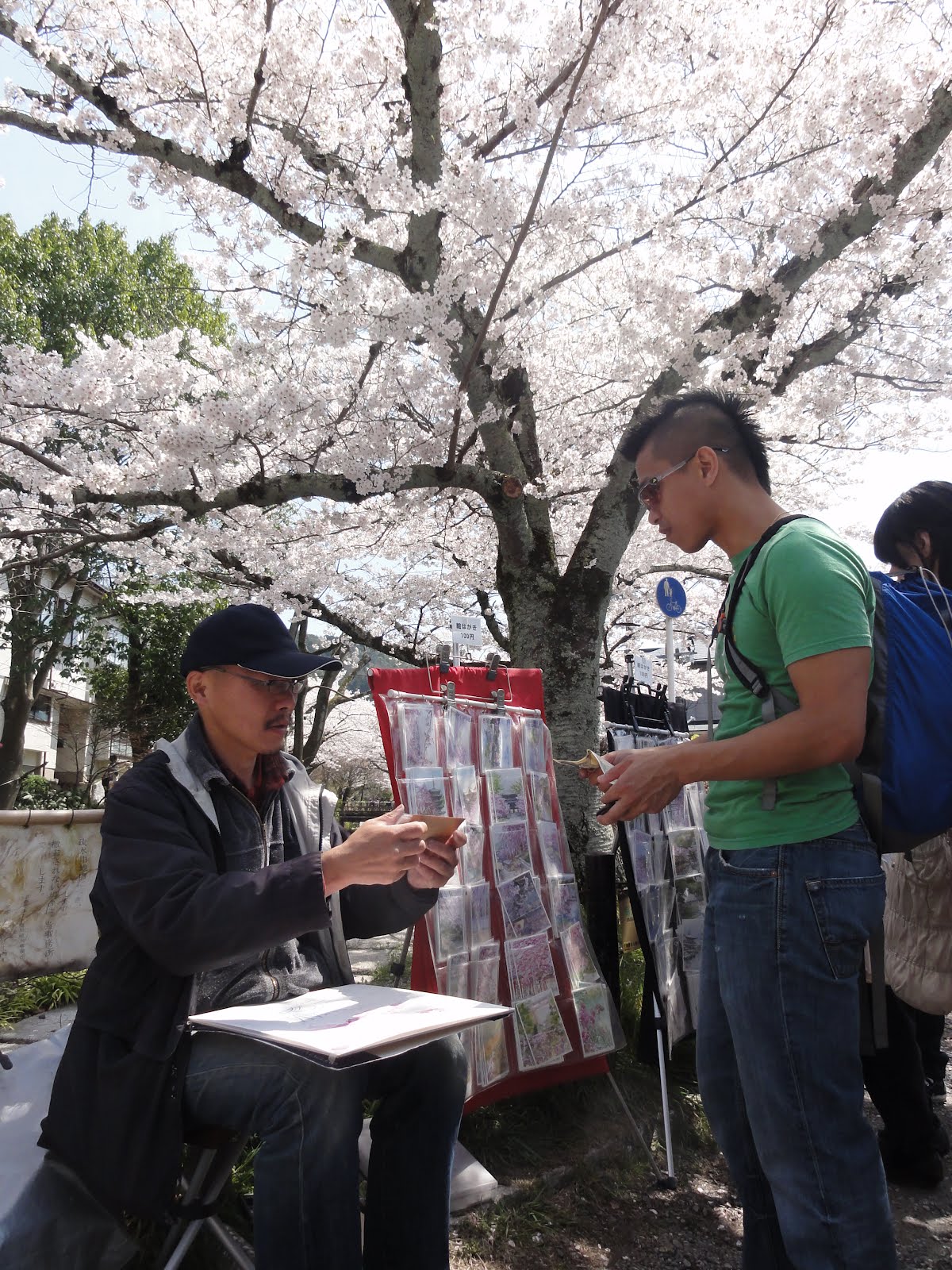
Artist Painting Cherry Blossoms and Selling Post Cards

Cherry Blossoms by a Canal

Cherry Blossoms by Tulips

Flower Arrangements

After spending the first day riding around Kyoto and doing quite a bit, we thought we'd take it easy on the second day and go out of the city center and visit one of the neighboring suburbs. Darin read somewhere that there was a flower arranging exhibition at a nearby temple. Though you'd think after a week of looking at cherry blossoms, we'd be sick and tired of seeing flowers, but we thought that this might be a little different from the ordinary sight.

It was pretty cool, but my tolerance for looking at arranged flowers is a little lower than Darin's.


Wednesday, April 11, 2012

Takayama

One of the things that Darin wanted to do in Japan was to visit the mountains of Japan. So we searched the internet looking for a place that our JR pass would take us and we found a town called Hida-Takayama, or just simply called Takayama. This town was a 2.5 hour (regular) train ride from Nagoya, with Nagoya being a 2 hour (shinkansen) train ride from Tokyo

Hida Folk Village & Old Town Takayama
Takayama is well known for Hida-no-Sato, which is a village of Edo period buildings that they have relocated from the Hida region. Edo period was between 1603 & 1868 when Japan was ruled by shoguns of the Tokugawa family. The village contained old houses and gave a glimpse of what it was like to live during this time. And since Hida is in the mountains, most of the houses here were made to withstand the snow with their thickly thatched, incline roofs.


Takayama also has a part of town with little, wooden stores selling wares, trinkets and lovely snacks.


Ryokan
Ryokans are Japanese Inns that was used during the Edo period for travellers. These inns would have tiny rooms featuring tatami mat covered floors and sliding doors. This room would be pretty much your living room and bedroom as the dining table would be pushed to the corner and your futon-like mattress would be rolled out on the floor. Today, ryokans are mainly used by tourist and so the price of a true ryokan would be more costly than staying at a standard hotel. But since we're in Japan, we do like the tourist do, shore up our budget, and stay one night at a ryokan in Takayama, Oyado Koto No Yume.

The whole experience was pretty great. We were warmly greeted at the large entryway and asked to be seated while they prepare our room and gather the necessary paperwork for our reservation. While seated, they provided us with a little snack, which we're quite not sure what it was except that it was yummy, and a cup of warm tea. It was the perfect start of the evening after a day strolling around the lovely little town of Takayama.


After having our tea, we were ushered to our room and was provided with yukatas. Yukatas are similar to kimonos except they are made of cotton to be used during spring and summer. The owners of the ryokan informed us that we can wear the yukatas during our stay and can even wear them around town if we choose to. Once inside our room, we played dress-up and put on our yukatas. We pretty much wore them from check-in to check-out except when we bathed and slept.


Ryokans are also known for having communal bath facilities, one for men and one for women. Similar to a Korean bathhouse, they have an area to shower, though done sitting on stools, and a large bathing area. We've actually used them several times here in Japan since our hotel in Tokyo had one and so did our first hotel in Takayama. But the best one we've been to so far was the one at the ryokan we stayed at. The warm bath was larger than the other two, plus they had an outdoor bath, which felt great w/ the cool air and the warm water. Unfortunately, it would have been too tacky to have a camera in a communal bath, so we weren't able to take pictures.

After our bath, we opted to have a Japanese dinner served at the ryokan. Dinner at a ryokan is part of the experience, as they serve you several courses of delicious food. Some ryokan will serve your dinner in your room, but this ryokan had a dining room, so we at there with the other guests. Let me just say that the food was soooo good and the presentation was of course, well done.

The appetizer included baby squid, cherry blossom-flavored tofu, and rhubarb sushi.
Darin and Our Appetizer Tray

Place Setting

Appetizer

Following appetizer was salad, soup, and sashimi. The sashimi was our least favorite course, but it was still yummy.
Tuna, Squid, and Scallop Sashimi

Then we had our main courses starting with grilled fish.

Darin and Our Very Helpful Waitress

And then the main course was a tepenyaki grilled beef and vegetable. The Hida region is known for their beef, and after having Hida beef for dinner, we can see why. I've had kobe beef once and I remember how good it was. But I think this might have been just a little better.

So that was our two nights in a small town in Japan. On to the main attraction, Kyoto.